A U.S. government delegation landed in Cuba for the first time in nearly a decade, delivering stark demands to the island’s failing communist regime while offering a lifeline that exposes decades of failed socialist policies.
Story Snapshot
- First official U.S. government flight to Cuba outside Guantanamo Bay since 2016 marks renewed diplomatic pressure
- State Department officials demanded end to political repression, release of prisoners, and economic liberalization from collapsing regime
- U.S. proposed free Starlink internet access while Cuban President Díaz-Canel vowed to defend against intervention
- Trump administration maintains hardline embargo policy despite diplomatic outreach to crisis-stricken island
Diplomatic Mission Breaks Decade-Long Silence
A senior State Department official led a U.S. delegation to Havana last week, marking the first American government flight to land in Cuba outside Guantanamo Bay since 2016. The delegation met with Cuban government officials, including the grandson of retired Cuban leader Raúl Castro, in what represents a significant diplomatic engagement under the Trump administration. This visit breaks nearly ten years of isolation, signaling a potential shift in approach toward the island nation just 90 miles from American shores.
Washington Delivers Non-Negotiable Demands
U.S. officials presented Cuba’s government with a clear list of requirements: end political repression, release political prisoners, and liberalize the island’s failing economy. The delegation insisted on economic reforms that prevent benefits to the Cuban government, military, intelligence, or security agencies. These demands align with the Trump administration’s National Security Presidential Memorandum from June 2025, which reinforces the decades-old embargo and restricts financial transactions benefiting Cuba’s armed forces. The administration characterizes the Cuban regime as both ineffective and abusive, framing continued pressure as necessary to prevent regional instability.
Starlink Offer Highlights Communist Failure
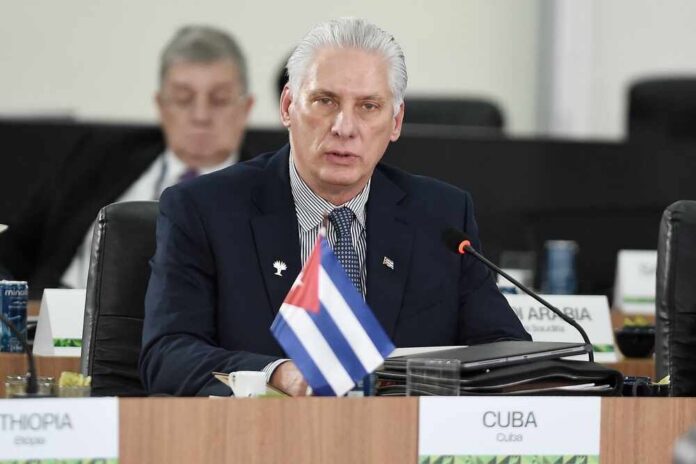
Among the proposals, U.S. officials offered to provide free and reliable internet to Cuban citizens through Starlink satellite technology. This humanitarian gesture underscores a damning reality: after more than six decades of communist rule, Cuba’s regime cannot provide basic modern infrastructure to its own people. The internet proposal represents both an olive branch and an implicit acknowledgment that opening information access could accelerate the regime’s collapse. Cuban President Miguel Díaz-Canel rejected characterizations of his government as a security threat, asserting Cuba’s readiness to defend itself against intervention while facing mounting economic crisis.
Failed Socialist Experiment Reaches Breaking Point
Cuba’s current predicament reflects the inevitable outcome of authoritarian socialist governance. The island nation faces deepening economic crisis following what the Trump administration describes as necessary pressure on an oppressive regime. Since the 1959 revolution, Cuba has endured a U.S. embargo spanning over 60 years, yet the regime’s failure to provide for its citizens stems primarily from its own centralized economic model. The Obama administration briefly attempted normalization from 2015 to 2017, easing travel restrictions and import regulations, only to see those policies reversed when Trump returned to office and tightened restrictions in response to human rights abuses and protest crackdowns.
Regional Implications and Strategic Calculations
The diplomatic mission signals Washington’s preference for negotiated regime change over military intervention, despite maintaining maximum economic pressure. Cuba’s response will determine whether sanctions ease or escalate, with implications extending beyond the island. Regional stability depends partly on whether Havana implements demanded reforms or continues its current path toward complete economic collapse. The Trump administration’s hardline stance maintains the statutory tourism ban, requires full-time engagement with Cuban civil society for permitted travelers, and mandates regular compliance audits. These measures aim to prevent the regime from benefiting financially while creating pressure for fundamental political and economic transformation.
Government Failures on Both Sides
This diplomatic dance reveals broader frustrations with Washington’s foreign policy establishment. For decades, the Cuba policy has oscillated between engagement and isolation based on which party controls the White House, with little regard for developing a coherent long-term strategy that actually serves American interests. Meanwhile, ordinary Cubans suffer under a regime that has failed to deliver prosperity or freedom, even as American policymakers debate whether Cold War-era approaches remain relevant. The outcome of this renewed engagement will test whether either government—Cuban or American—can move beyond failed orthodoxies to address the genuine needs of the Cuban people for political freedom and economic opportunity.
Sources:
U.S. and Cuban officials met recently in Havana amid new diplomatic push
National Security Presidential Memorandum (NSPM-5)
Move on from Washington’s outdated Cuba policy