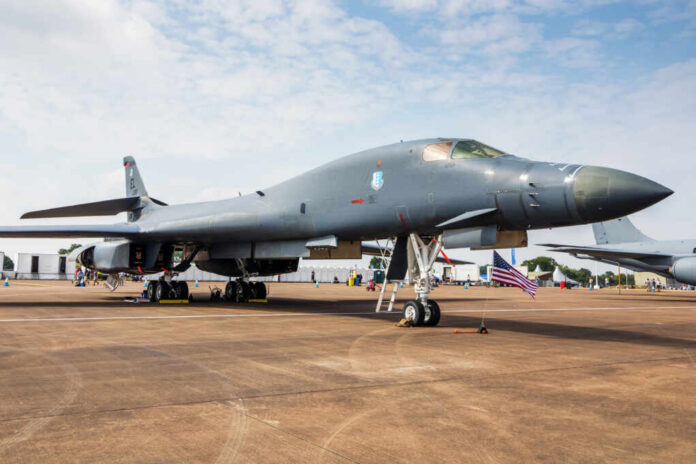
President Trump’s Air Force refuses to retire the battle-proven B-1B Lancer despite leftist media calling it a “failure,” choosing instead to supercharge it into a missile truck to crush threats from China and Russia.
Story Highlights
- USAF retains ~45 B-1Bs with major upgrades like LAM pylons boosting missile load to 36 JASSM/LRASM/hypersonics, countering “bomber gap” until B-21 arrives around 2032.
- Fleet drawdown from 100 to 45 active airframes after retiring 17 weakest ones; two regenerating to replace crash-damaged jets, proving Reagan-era platform’s enduring value.
- FY25 upgrades include digital cockpits, Link-16 data links, and hypersonic integration, extending service to 2040+ for Pacific deterrence against communist aggressors.
- Congress overrides retirement pushes, mandating preservation for national security—real leadership prioritizing American strength over wasteful new spending.
- Proven in 12,000+ combat sorties, B-1B bridges to B-21, sustaining jobs and firepower without Biden-era delays or globalist cuts to defense.
B-1B Lancer Defies Obsolescence Label
The B-1B Lancer entered U.S. Air Force service in 1985 as a supersonic variable-sweep wing bomber designed for low-altitude nuclear penetration against Soviet threats. President Reagan revived the program after Carter’s cancellation, leading Rockwell—now Boeing—to build 100 airframes. The “Bone” shifted to conventional roles in the 1990s, flying over 12,000 sorties in Iraq, Afghanistan, Libya, and Syria while delivering massive ordnance. This combat record underscores its reliability, countering media narratives of failure amid high maintenance and age.
Strategic Upgrades Bridge to B-21 Raider
Air Force Global Strike Command manages about 45 active B-1Bs at bases like Dyess and Grand Forks, down from 100 due to retirements and crashes including the 2023 Ellsworth incident. The 2020 Integrated Battle Station upgrade added digital cockpits, Fully Integrated Data Link for Link-16 networking, and systems monitoring over 9,000 parameters. FY25 brings Load Adaptable Modular pylons, increasing external missile carriage by 12 for a total of 36 JASSM, LRASM, or hypersonics—tested in captive carry and release. These enhancements transform the B-1B into a standoff “missile truck” vital against peer adversaries.
Congress and Boeing Ensure Longevity
U.S. Congress preserved 44-45 airframes despite Air Force retirement proposals, controlling budgets for LAM and other modernizations in FY25 and beyond. Boeing, as sustainment contractor, positions the fleet “future ready to 2040+” through open systems and digital upgrades like radio crypto for MUOS SATCOM. Two airframes regenerate to offset damaged ones, with Ellsworth personnel relocating to Grand Forks in December 2024 to prepare B-21 facilities. This teamwork avoids capability gaps during B-21 low-rate production delays.
Hypersonic test roles shift from B-52 to B-1B, with budget documents stressing “near-term increased volume of fires.” First IBS-modified jet unveiled at Dyess in Fall 2023 under the “Embracing Agile Scheduling Team Beast” initiative. These steps hedge B-21 timeline risks targeting 2032 entry.
Boosting Deterrence and American Jobs
Short-term, upgrades enhance Pacific operations firepower against China and Russia, lifting readiness for AFGSC squadrons while supporting Boeing contracts and bases like Dyess. Long-term, B-1B serves into 2030s-2040 as a conventional and hypersonic bridge, avoiding a dangerous bomber shortfall. This cost-effective approach sustains aviation jobs versus rushing smaller B-21 fleets. Politically, it reinforces U.S. deterrence through the bomber triad commitment, with experts praising adaptability: “In 2 Words: More missiles.” Under President Trump, such pragmatic defense wins protect freedom without fiscal recklessness.
B-1B Lancer “Failure”? Why the Air Force Won’t Retire This Bomber for 1 Reasonhttps://t.co/YTNiDsmkVi
— 19FortyFive (@19_forty_five) February 11, 2026
Expert consensus from Air & Space Forces Magazine and 19FortyFive affirms upgrades outweigh age concerns, ensuring standoff munitions integration. No major dissenting views emerge, validating the one key reason: strategic necessity trumps premature retirement.
Sources:
Air & Space Forces Magazine on B-1 Weapons and Upgrades
19FortyFive: The New Super B-1B Lancer Summed Up In Just 2 Words: Russia and China Will Hate
Boeing: B-1B Lancer
Military.com: B-1B Lancer
Simple Flying: How Many B-1 Bombers Are Left?