Federal agents arrested the niece of slain Iranian commander Qassem Soleimani after Secretary of State Marco Rubio stripped her green card, exposing how foreign nationals tied to a U.S.-designated terrorist organization lived lavishly in Los Angeles while celebrating attacks on American forces.
Story Snapshot
- ICE arrested Hamideh Soleimani Afshar and her daughter on April 3-4, 2026, after Rubio revoked their lawful permanent resident status for promoting Iranian regime propaganda
- State Department accused the pair of supporting the IRGC, praising attacks on U.S. troops, and calling America the “Great Satan” while enjoying a luxury lifestyle in L.A.
- The arrests follow a broader Trump administration crackdown targeting Iranian nationals with regime ties, including recent deportations of another Iranian official’s family
- Iranian state media denied the family relationship, calling U.S. claims a “lie,” highlighting conflicting narratives in escalating U.S.-Iran tensions
Trump Administration Enforces Zero Tolerance on Terror Supporters
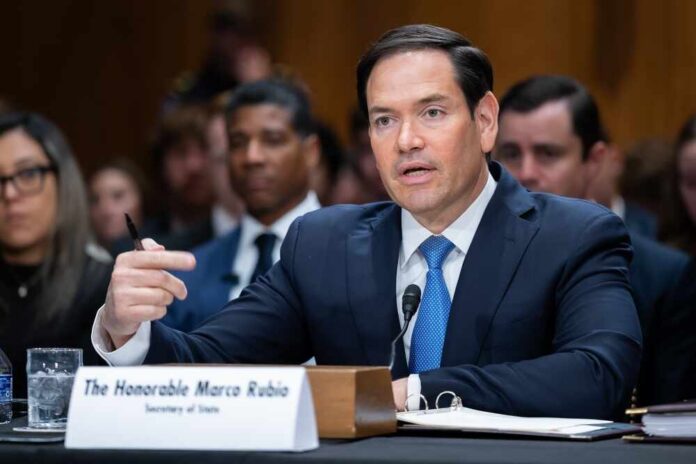
Secretary of State Marco Rubio revoked the green cards of Hamideh Soleimani Afshar and her unnamed daughter after federal authorities identified them as relatives of Qassem Soleimani, the IRGC Quds Force commander killed by a U.S. drone strike in January 2020. ICE agents arrested both women late Friday, April 3, 2026, in Los Angeles. The State Department confirmed Saturday that the pair remains in ICE custody pending deportation proceedings. Afshar’s husband has been permanently barred from entering the United States. This action signals the administration’s refusal to allow individuals with terrorist regime connections to exploit American residency privileges.
Social Media Posts Reveal Anti-American Activity
The State Department accused Afshar of promoting Iranian regime propaganda through social media while residing in luxury in Los Angeles. Evidence cited includes deleted Instagram posts celebrating attacks on U.S. forces, praising Iran’s leadership, and expressing support for the Islamic Revolutionary Guard Corps, which the U.S. designated as a foreign terrorist organization. Rubio highlighted in a post on X that Afshar referred to America as the “Great Satan,” a regime slogan embodying Iran’s hostility toward the United States. The contrast between her anti-American rhetoric and comfortable California lifestyle underscores the administration’s concern about foreign nationals undermining national security from within U.S. borders.
Pattern Emerges in Immigration Enforcement Strategy
The Soleimani arrests follow deportations earlier in April 2026 of Fatemeh Ardeshir-Larijani, daughter of slain Iranian official Ali Larijani, and her husband Seyed Kalantar Motamedi, whose immigration statuses Rubio also revoked. Ali Larijani was killed in an Israeli airstrike in March 2026. The Trump administration revoked visas of Iranian UN mission diplomats and staff in late 2025, establishing a pattern of targeting individuals linked to Tehran’s regime apparatus. These cases demonstrate expanded use of executive authority to deport green card holders based on social media activity supporting designated terrorist groups. Immigration enforcement agencies now have precedent for scrutinizing online behavior of foreign nationals from adversarial nations residing in the United States.
Iranian Regime Denies Family Connection
Iranian state-aligned Fars News reported that Zeinab Soleimani, daughter of Qassem Soleimani, explicitly denied any family relationship with the arrested women, calling U.S. claims a fabrication. This denial attempts to discredit American assertions and deflect attention from regime supporters exploiting U.S. residency. The conflicting narratives reflect broader information warfare between Washington and Tehran. U.S. officials based their identification on social media evidence and confirmed family ties, while Iran seeks to portray the arrests as politically motivated propaganda. The denial also raises questions about whether the regime is distancing itself from embarrassing revelations or genuinely disputing kinship claims.
Implications for National Security and Immigration Policy
These arrests carry significant implications for how the administration polices foreign nationals with terrorism ties. The cases establish that lawful permanent resident status offers no protection for individuals promoting attacks on Americans or celebrating designated terrorist organizations. Iranian diaspora communities, particularly in Los Angeles, may face heightened ICE scrutiny based on regime connections and online activity. Long-term effects include stricter vetting of green card holders from adversarial nations and potential expansion of social media monitoring for immigration enforcement purposes. The precedent raises constitutional concerns about free speech versus national security, though support for foreign terrorist organizations falls outside First Amendment protections. For Americans frustrated by past administrations’ tolerance of anti-American sentiment, this enforcement represents a welcome assertion of sovereignty and security priorities.
Sources:
US agents arrest niece of Iran’s Qassem Soleimani after Rubio revoked green card
US arrests niece, grandniece of slain Iran General Qassem Soleimani
US agents arrest relatives of slain Iranian commander Qassem Soleimani
US arrests niece and grandniece of slain Iran general Qassem Soleimani
Trump administration arrests relatives of Iran general Soleimani
Soleimani’s daughter denies detained woman in US is her relative