A Cold War bomber packed with cutting‑edge tech just went down on a U.S. test range, killing eight Americans and raising fresh questions about who is really watching the people who watch over us.
Story Snapshot
- A U.S. Air Force B-52 bomber crashed on takeoff at Edwards Air Force Base during a routine test mission.
- All eight people on board are presumed dead, including military members, civilian employees, and contractors.
- The jet was supporting a radar modernization program, part of the long and costly push to keep the aging B-52 flying for decades.
- Officials say the cause is unknown and will take months to investigate, leaving a vacuum filled with grief and distrust.
What We Know So Far About the Crash
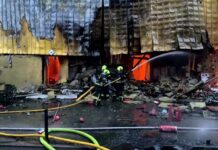
Military leaders at Edwards Air Force Base in California say a U.S. Air Force B-52 Stratofortress crashed shortly after takeoff around 11:20 a.m. during what they called a routine test mission. The aircraft went down on the base runway in the Mojave Desert and burst into flames, sending a thick plume of black smoke into the sky as emergency crews rushed to the scene.[1] Officials quickly closed the airfield and diverted other aircraft while firefighters worked to contain the blaze.[1]
Edwards officials later confirmed that eight people were on board the bomber and that the crash was “unsurvivable,” meaning all eight are presumed dead.[1][2] A senior base officer said the crew included a mix of uniformed service members, government civilian workers, and government contractors supporting the test mission.[2] He explained that next-of-kin notifications were underway and that names will not be released until families are notified, a process that can take at least twenty‑four hours.[2]
A Test Flight, An Old Bomber, and a High-Tech Upgrade
Officials said the B-52 was flying a local test mission linked to a radar modernization program for the bomber fleet.[2] The plane took off and crashed almost immediately, with video and photos showing wreckage and debris scattered along the runway area.[2][6] The B-52, first flown in the 1950s, is described by the military as a long-range heavy bomber and “backbone” of the U.S. manned strategic bombing force, and the Air Force plans to keep it flying into the 2050s or beyond.[1]
That plan depends on costly upgrades, including new active electronically scanned array radar, new engines, and updated avionics. Test flights like this one are part of that effort to turn a jet designed for the nuclear standoff with the Soviet Union into a platform that can carry modern weapons deep into contested airspace today.[5] For many Americans on both the right and the left, this mix of aging airframes and billion‑dollar upgrade programs raises hard questions about where defense dollars go and who benefits.
The Investigation Timetable and the Information Gap
Edwards officials said they do not yet know why the bomber went down and warned that answers will not come quickly.[2] They described a standard process: an interim safety board gathers facts first, then a formal safety investigation board looks for root causes, followed later by an accident investigation board.[2] They said an initial safety review could take about thirty days, while the full accident investigation may take up to six months before more details can be shared with the public and with families.[2]
This slow timeline is common after major military accidents, but it leaves a large information gap that many Americans no longer trust the government to fill fairly. The same institution that owned, maintained, and flew the aircraft also controls the logs, data, cockpit voice recordings, and internal emails that might reveal whether mechanical problems, human error, or deeper systemic issues played a role. For citizens who already suspect that the “deep state” protects its own, that closed loop is exactly what worries them.
Why This Hits a Nerve Across the Political Spectrum
People on the right often see stories like this through a lens of waste and mismanagement. They look at an airframe older than most of the crew, kept alive by massive spending, and wonder how many trillions have gone to contractors while the border remains open and working families struggle with prices and taxes. People on the left may look instead at the growing gap between elite decision makers and ordinary workers, noting that some of the dead were likely civilian specialists whose names will never trend for long.
B-52 Stratofortress Crashes at Edwards AFB, All 8 on Board KilledA U.S. Air Force B-52 Stratofortress crashed shortly after takeoff during a radar modernization test flight at Edwards Air Force Base in California’s Mojave Desert on June 15, 2026. Thick black smoke was visible… pic.twitter.com/5FjsFzHb3P
— Dhaka Pulse 24/7 (@dhaka_pulse) June 16, 2026
What both sides increasingly share is the sense that no one truly accountable will pay a price if this crash turns out to involve preventable failures. Past B-52 accidents show how long it can take for the truth to surface and how rarely it leads to deeper change.[4] As with earlier crashes, the official line will likely stress heroism, “thoughts and prayers,” and the need to “let the investigation run its course,” while the real decisions about money, risk, and oversight stay hidden behind secure doors.
What to Watch in the Weeks Ahead
Several key details will show how serious leaders are about real transparency. First is whether investigators release a clear, detailed account of the cause, including any maintenance history, test-risk assessments, or waiver documents that might show corners were cut. Second is how openly they address the mix of military and contractor roles on the flight, and whether private firms face scrutiny alongside Air Force commanders, or are shielded behind contracts and classified annexes.[2][5]
Finally, Americans should watch whether this tragedy sparks any honest debate in Washington about the broader direction of U.S. defense policy. An aging bomber crashing on a secretive test mission, killing eight people on American soil, is not just an accident scene; it is a symbol. It captures a government that can field incredible technology, move huge sums of money, and yet still struggle to deliver basic safety, straight answers, and a sense that the system values human lives more than hardware and careers.
Sources:
[1] YouTube – Air Force B-52 bomber crashes at Edwards Air Force Base
[2] Web – B-52 bomber crashes at Edwards Air Force Base in California
[4] Web – US Air Force B-52 bomber crashes after takeoff … – Al Jazeera
[5] YouTube – U.S. Air Force B-52 Stratofortress crashes after takeoff on Edwards …