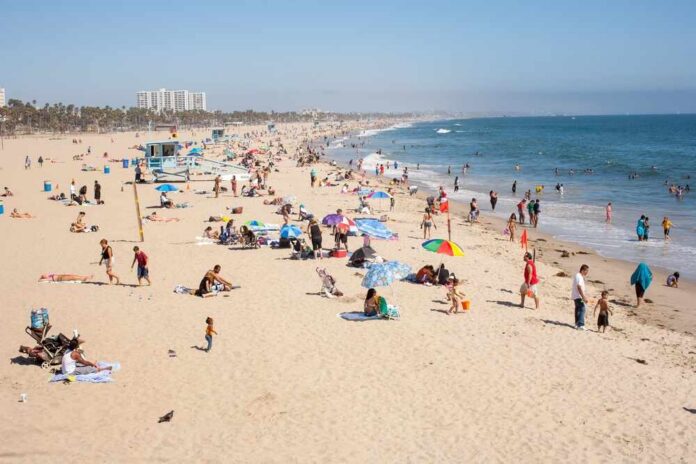
Nothing says “failed priorities” like families fleeing a heat wave—only to be told the ocean water at major Los Angeles County beaches may make them sick.
Story Snapshot
- Los Angeles County health officials issued ocean-water contact warnings for 11 beach locations after samples showed bacteria levels above state health standards.
- The warnings came as a March heat wave pushed more residents to the coast, increasing potential exposure—especially for kids and seniors.
- Advisories focus on higher-risk spots near storm drains, creeks, piers, and lagoons where contamination can concentrate.
- Officials direct the public to a county hotline and a live advisory website while agencies resample and update postings.
11 Beach Locations Flagged as Heat Sends Crowds to the Shore
Los Angeles County’s Department of Public Health issued warnings against entering ocean water at 11 specific beach areas after recent samples found elevated bacteria that exceeded state health standards. The timing matters: the warnings were announced during a Southern California heat wave that drove more people toward the coast for relief. Health officials emphasized that higher bacteria levels increase the risk of illness, turning what should be a simple day out into a public-health calculation.
Public agencies did not present the advisory as a vague “better safe than sorry” suggestion. The county framed it as a standards-based warning tied to test results and public reporting procedures, with updates distributed through posted beach notices, a hotline, and an online advisory page. That process is important for families deciding whether to swim, wade, or let children play at the waterline—where accidental ingestion and skin contact are common.
Why Some Shoreline Areas Repeatedly Become Trouble Spots
Los Angeles County’s beach warnings repeatedly point people to the same types of locations: areas near storm drains, creeks, piers, and lagoons. Those features function like funnels, concentrating runoff and contaminants that flow from dense urban neighborhoods to the shoreline. The county’s guidance highlights that these locations tend to be higher risk, which is why beachgoers are urged to avoid water contact around outfalls even when the broader coastline looks clean and inviting.
Unlike the more familiar pattern—countywide cautions that follow rainfall—the March 2026 situation was reported alongside heat-wave conditions and increased beach attendance. It does not specify the exact sample collection dates or a single triggering event beyond the test exceedances, so the precise reason for the spike at each site remains limited to what officials have published. What is clear is the county’s position that the illness risk is real when readings surpass state limits.
How LA County Monitors, Resamples, and Decides When to Lift Warnings
Beach water monitoring in Los Angeles County is not a one-off operation. County health officials describe a year-round program built on routine sampling and follow-up resampling when results fail to meet state standards. Multiple public entities take part, including the county health department and local sanitation partners, with some sites sampled weekly and certain locations tested more frequently. Warnings remain in place until follow-up results show bacteria levels back within standards.
The county also notes a common rule of thumb for contamination after runoff events: bacteria levels can remain elevated for up to about three days, depending on local conditions. While this specific March episode was reported during a heat wave, the same caution about avoiding water near outlets still applies. For residents already tired of government dysfunction, the practical takeaway is straightforward: pay attention to posted warnings and treat “looks fine” water as unreliable near drainage features.
What the Warnings Mean for Families, Local Tourism, and Public Trust
Health warnings during a heat wave land hardest on working families and seniors who rely on public beaches for affordable relief. Even temporary restrictions can redirect crowds to other stretches of coastline or push people to ignore advisories, raising the odds of stomach illness, rashes, and other exposure-related problems. Economically, repeated warnings near iconic destinations can also disrupt local businesses that depend on consistent beach traffic, especially when the weather should be boosting visitation.
https://twitter.com/zerohedge/status/2034797096558080436
Politically, the episode underscores a basic expectation taxpayers share across party lines: public infrastructure should keep recreational waters safe, not trigger routine warnings at the exact moment people need relief. No costed plan or a single policy fix, and it does not assign blame to a specific officeholder. It does, however, reinforce the long-running reality that urban runoff and shoreline outfalls remain recurring vulnerabilities—problems that demand competent management rather than messaging.
Sources:
County Warns Against Ocean Water Contact As Heat Wave Builds
Los Angeles County Department of Public Health – Beach Water Quality Advisories