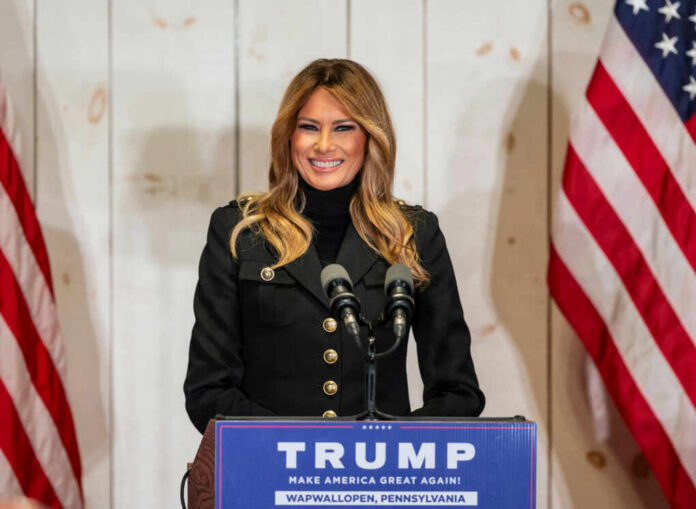
Melania Trump just forced the Epstein story away from meme culture and back into sworn testimony—while demanding Congress put victims on the record.
Quick Take
- First Lady Melania Trump delivered a rare White House statement on April 9, 2026, denying any friendship or involvement with Jeffrey Epstein or Ghislaine Maxwell.
- She disputed claims that Epstein introduced her to Donald Trump and described her limited contact with Epstein as incidental social overlap.
- Melania addressed a widely circulated email to Maxwell, calling it casual correspondence that has been used to fuel misleading narratives.
- She urged Congress to hold hearings allowing Epstein victims to testify under oath, shifting the focus from rumors to verifiable public record.
A rare White House appearance aimed at shutting down a persistent narrative
Melania Trump’s April 9 White House address centered on a categorical denial: she said she was never a friend of Jeffrey Epstein, never had a relationship with him, and had no involvement in his crimes. She also rejected claims tying her to Ghislaine Maxwell beyond limited social familiarity. Major outlets framed the speech as unusual precisely because she so rarely speaks publicly, and because the subject has circulated for years online.
Melania’s statement also tackled a specific allegation that has lingered in political commentary—that Epstein introduced her to Donald Trump. She said she met Trump in 1998 at a New York City party and that Epstein was not part of that introduction. She placed her first direct encounter with Epstein later, around 2000, describing it as a one-time meeting in a broader social setting rather than an ongoing relationship.
What the email controversy shows—and what it does not prove
A recurring piece of “evidence” in online attacks has been an email to Maxwell signed “Love, Melania.” Melania addressed it head-on, characterizing the message as trivial and consistent with the superficial etiquette of elite social circles. The speech can interpret the tone differently, but none establishes that the email shows criminal knowledge, participation, or an ongoing friendship.
This distinction matters because Americans across the political spectrum are exhausted by a system where insinuations travel faster than facts. Conservatives often see the pattern as weaponized smear culture, while many liberals see it as another example of elites escaping accountability. The reality is that a single cordial email, without more corroboration, is a weak basis for sweeping claims. Melania’s approach was to deny, then redirect attention to evidence that can be tested.
From personal defense to a public challenge: put victims under oath
The most consequential part of Melania’s remarks was her call for congressional hearings where Epstein victims can testify under oath and enter their accounts into the Congressional Record. In practical terms, that would move the issue from selective leaks and social-media narratives to formal testimony with legal consequences for false statements. Coverage characterized this pivot as politically risky, especially in a climate where Epstein-related disclosures are routinely used as ammunition by both sides.
Her push also lands at a time when Epstein file oversight remains contentious. Reporting referenced subpoena-related friction involving former Florida Attorney General Pam Bondi and ongoing demands for transparency. Melania’s request does not resolve those disputes, but it does clarify what kind of process she says should happen next: a structured forum where victims speak for themselves, lawmakers ask questions on the record, and the public can evaluate claims using official documentation rather than viral clips.
Why the statement matters in 2026 politics
In a second Trump term with Republicans controlling Congress, Democrats still have incentives to keep Epstein-adjacent controversy in the headlines, while many Republicans have incentives to avoid the topic altogether. Melania’s statement complicates that simple political script. She did not merely deny allegations; she called for action that could expose additional elite networks beyond any one party. If hearings occur, they could strengthen public trust through transparency—or deepen distrust if they appear stage-managed.
Melania gives statement on Jeffrey Epstein, diverging from Trump https://t.co/5xFDmaoHS8 | WHY THE FUCK ARE YOU DOING THIS IN FRONT OF AMERICAN FLAGS!!! @MELANIATRUMP @realDonaldTrump GO AWAY!
— CriticalCareMonthly (@criticalcaremon) April 10, 2026
For voters who already believe the federal government serves insiders first, the episode is a reminder of two competing failures: misinformation that can damage reputations without proof, and institutional reluctance to create a clean public record when allegations involve powerful people. Melania Trump’s demand—sworn victim testimony—implicitly challenges both problems. The open question is whether Congress follows through with a process rigorous enough to satisfy a country that no longer trusts press narratives or partisan soundbites.
Sources:
First Lady Melania Trump’s Statement on Jeffrey Epstein (White House Address).
Melania Trump’s Epstein White House address