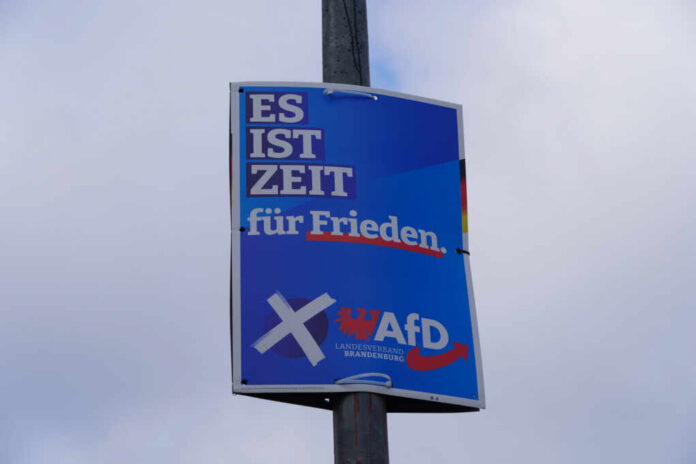
Germany’s populist Alternative for Germany party has surged to its highest polling levels ever recorded, overtaking the establishment CDU and sending shockwaves through the European political order — and AfD leader Alice Weidel says the shift is only beginning.
Story Highlights
- A GMS poll placed the Alternative for Germany (AfD) at 27% nationally, three points ahead of Chancellor Friedrich Merz’s CDU/CSU at 24% — a dramatic reversal from just one year ago when the CDU led 33% to 18%.
- An INSA poll recorded AfD at a historic high of 26.5%, the highest figure ever recorded by that institute, with the party’s “certain to vote” base now at 21% — exceeding even its 2025 federal election performance.
- In eastern Germany, AfD dominance is even more pronounced, with Saxony-Anhalt polls showing the party near 40%, roughly 14 points ahead of the CDU.
- Despite the polling surge, mainstream German parties maintain a so-called “firewall” blocking AfD from coalition participation, meaning record poll numbers have not yet translated into governing power.
AfD Hits Historic Polling Highs Nationwide
Multiple independent German polls published in early 2026 show the Alternative for Germany (AfD) party reaching unprecedented national support levels. A GMS survey conducted between December 23 and January 5, questioning 1,027 Germans, placed AfD at 27% versus CDU/CSU at 24%. An INSA poll separately recorded AfD at 26.5%, marking the highest figure the polling firm has ever recorded for the party. AfD co-chairwoman Alice Weidel declared the results proof that “the political shift is inevitable.”
The polling reversal over a single year is striking. Brussels Signal reported that just one year prior, the same long-running GMS poll showed CDU/CSU at 33% and AfD at only 18%. That means the CDU has shed nine percentage points while AfD gained a corresponding amount. The INSA data adds another dimension: the share of AfD supporters who say they are “certain to vote” has grown to 21%, exceeding the party’s actual 20.8% result in the 2025 federal election, suggesting its support base is becoming more committed, not less.
Eastern Germany Becomes AfD’s Stronghold
AfD’s strength is especially pronounced in Germany’s eastern states. In Saxony-Anhalt, recent surveys place AfD support at approximately 39–40%, well ahead of the CDU’s roughly 26–27%. In Mecklenburg-Vorpommern, the party polls frequently in the 29–38% range. Hungarian Conservative reported that AfD has broken the 40% threshold in Saxony-Anhalt polling for the first time in German history. This regional institutionalization of AfD support signals that the party’s appeal has moved beyond protest voting in key parts of the country.
The pattern in the east reflects broader voter frustrations that resonate beyond Germany’s borders — anger over mass migration, skyrocketing energy costs, economic stagnation, and distrust of an out-of-touch political establishment. These are the same pressures that drove populist victories across the Western world, including Donald Trump’s return to the White House. German voters in the east, who lived under Soviet-era central planning, appear especially resistant to being told by elites which parties they are permitted to support.
The “Firewall” Problem — Polling Strength vs. Political Power
Despite the historic polling numbers, AfD faces a significant structural obstacle. Germany’s mainstream parties — CDU/CSU, the Social Democrats, the Greens, and others — maintain an informal but firm agreement to exclude AfD from any governing coalition at the federal and state levels. This so-called “firewall” means that even if AfD finishes first in an election, it cannot form a government without partners, and no mainstream party will provide them. The practical effect is that AfD can win voters but remains locked out of actual power.
"The Political Shift Is Inevitable": AfD Leader Weidel Heralds New Polling High For Party https://t.co/EBOxCSHd5g https://t.co/bazyz7tn7o$SPY $TSLA $AMZN $GOOGL $QQQ $HOOD $NVDA $AAPL $MFST $AMD $META $PLTR $CAR $BYND $OPEN $RKLB $ASTS $MVRL $QCOM pic.twitter.com/m3v96NuBYB
— Florida Man (@FloridaMan729) May 19, 2026
It is worth noting that polling results are not uniform across survey houses. A Forsa poll conducted ahead of the 2025 federal election showed CDU/CSU at 29% and AfD at 21%, a significant gap. This variation across pollsters means claims of a fully settled realignment should be treated with some caution. What the data does clearly show is a sustained, multi-poll competitive surge — not a single outlier — combined with a deeply committed voter base and dramatic year-over-year gains. Whether that translates into governing authority depends less on voters and more on whether Germany’s political establishment eventually abandons its strategy of exclusion. For now, Weidel and AfD are winning the argument in the polls. Winning in parliament is another matter entirely.
Sources:
[1] YouTube – Far-right AfD becomes Germany’s strongest party shock polls show
[2] Web – AfD Extends Lead over CDU in First 2026 Poll
[3] Web – AfD reaches biggest-ever lead over CDU in nationwide poll, set to …
[4] Web – AfD Surges to Record High, Overtaking CDU
[5] YouTube – Alice Weidel | Young Voters Are Powering The Rise Of …
[6] YouTube – Merkel’s CDU defeats far-right AfD in crucial German state election
[7] Web – AfD Breaks 40 Per Cent Threshold for First Time in German History
[9] YouTube – Polls show far-right party is on course for its highest-ever vote …
[10] YouTube – Germany Election 2025 LIVE | AFD leader Alice Weidel Speaks LIVE
[11] YouTube – AfD nearly doubles support from last election | DW News
[12] YouTube – Why 2026 could be a milestone for Germany’s AfD