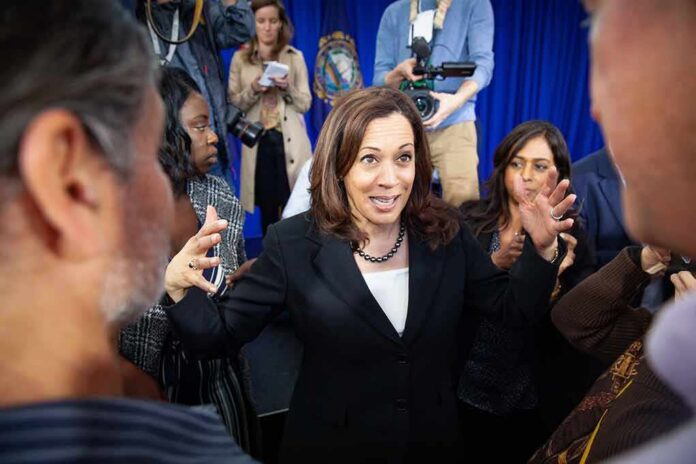
At a Sacramento campaign stop, Kamala Harris’s team and Richard Pan’s campaign limited press access while Harris delivered a nine-minute pitch for Pan’s House bid — a small event with big First Amendment overtones.
Story Highlights
- Harris spoke for about nine minutes at Pan’s North Natomas headquarters, focusing on his House race.
- Some news outlets were blocked from covering parts of the appearance, prompting access complaints.
- Pan’s team and Harris’s aides pointed to each other over who drove the press restrictions.
- The flap reflects a wider trend of tighter campaign message control and dwindling media access.
What Happened In Sacramento
On October 2, 2026, Kamala Harris appeared at Richard Pan’s campaign headquarters in North Natomas. Harris spoke for about nine minutes to a crowd of supporters. She praised Pan’s record and targeted his opponent in California’s 6th Congressional District race. Local reporting places the event and its length clearly at Pan’s headquarters that afternoon. Harris’s visit was brief and focused on a direct appeal to volunteers and voters working to flip or hold a House seat.
During the same stop, some news organizations were blocked from parts of the appearance. KCRA 3 reported that it and other outlets were denied access to cover the public component. The outlet called attention to the decision and asked for an explanation from both campaigns. The restriction did not stop all coverage, as other local outlets reported on the event, but it did limit in-person reporting by certain crews.
The Dispute Over Press Access
After the event, a blame game broke out over who decided to restrict access. Ground News’ roundup cited Pan’s team saying Harris’s office directed credentialing, while a Harris aide said Pan’s staff handled press for the stop. That split explanation shows how fast access calls can become political when a high-profile figure appears at a small venue with limited space and tight schedules. Harris’s remarks themselves lasted only nine minutes, heightening the stakes of who got in.
Other outlets described the scene as limited in size, with roughly 100 people inside the headquarters. Those reports matched the short format and targeted purpose of the stop. The focus stayed on Pan’s race and a contrast with his opponent. The press-access fight became the separate headline, drawing attention away from Harris’s message and toward how campaigns manage coverage in the final stretch before voting.
Why This Matters Beyond One Event
Press restrictions at campaign events are not new. Campaigns often shape access to keep the message tight and surprises low. But locking out select outlets, even at small venues, fuels a larger concern shared by many Americans: powerful people pick who gets to ask questions, and ordinary voters lose a key check on spin. Media experts note that campaigns now rely less on reporters because they can reach voters directly online.
Courts have drawn sharper lines when the government itself limits access to official functions. Judges have ruled that the government cannot punish outlets for coverage by stripping their access to public events, affirming basic First Amendment protections. Campaign stops are different from White House briefings, yet the public principle is similar: fair access supports trust, while selective doors breed doubt and division. Sacramento’s dust-up is a small case that shows a big trend.
Sources:
twitchy.com, thegatewaypundit.com, ground.news, hoodline.com, thewrap.com