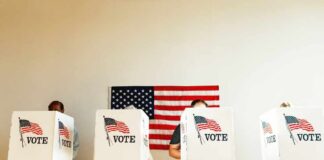
A federal judge just shut down President Trump’s attempt to add proof-of-citizenship to the federal voter registration form—forcing Republicans to fight the voter-ID battle the hard way: through Congress.
Story Snapshot
- A federal district court permanently blocked the Election Assistance Commission from implementing Trump’s executive-order push to change the federal registration form.
- Senate Republicans moved the “SAVE America Act” forward with a 51-48 vote to begin debate, but Democrats are preparing a marathon filibuster.
- The bill would require documentary proof of citizenship for registration and photo ID for voting, while tightening rules around mail voting and online registration.
- The debate is as much about constitutional authority and trust in institutions as it is about fraud prevention versus voter access.
Court Blocks Trump’s Executive Route, Forcing a Legislative Showdown
May 2026 brought a clear judicial rebuke to the administration’s executive approach: a federal district court permanently enjoined the U.S. Election Assistance Commission from adding a documentary proof-of-citizenship requirement to the federal voter registration form. The ruling underscored a basic constitutional tension that keeps surfacing in election fights—states and Congress have primary responsibility for election regulation, while presidents face limits when acting unilaterally through agencies.
The immediate effect is political as much as procedural. Trump can still argue that tighter rules are necessary for election integrity, but the court decision means the administration cannot simply direct the EAC to rewrite how Americans register nationwide. For voters already convinced Washington is run by self-protective “elites,” the back-and-forth is another reminder that major policy changes often hinge on judges and bureaucratic process, not just elections.
What the SAVE America Act Would Change for Voters
Republicans are now leaning on Congress through the SAVE America Act (Save America Votes and Elections Act), which is being debated in the Senate after a 51-48 vote to begin consideration. The bill’s core provisions include requiring documentary proof of citizenship to register and mandating photo identification to cast ballots. It also targets mail voting by requiring photocopies of ID for mail ballot applications and submissions.
The measure would also eliminate online voter registration and restrict mail-in voting more broadly, while leaning on Department of Homeland Security verification tools to screen citizenship claims. Supporters see these steps as common-sense guardrails that match everyday life—Americans show ID to board planes, buy certain products, and access government services. Critics counter that election rules are not the same as consumer transactions and warn the process changes could block eligible citizens.
Why Democrats Are Betting on the Filibuster—and Why the GOP Isn’t United
Senate Democrats have signaled unified resistance and appear ready to use the filibuster to prevent final passage. That reality matters because Republican control of the Senate does not automatically translate into 60 votes needed to end debate under current rules. Some Republicans are also cautious about changing the filibuster itself, weighing institutional precedent, potential political blowback, and the unpredictability of future majorities.
This is where the “government failing the people” frustration hits both sides. Conservatives often view the filibuster as an excuse for permanent obstruction even after elections deliver unified government. Many liberals, meanwhile, defend it as a necessary brake on majoritarian overreach. Either way, the result can look the same to the public: months of dramatic rhetoric, little clarity, and few durable reforms that voters can easily understand or trust.
Fraud Claims vs. Documented Evidence—and the Risk of Administrative Error
Trump’s messaging frames Democratic resistance as intentional—“they want to cheat”—but the research record summarized here does not provide empirical evidence establishing widespread fraud that would be directly addressed by these specific federal requirements. That gap is politically important because Americans who want clean elections also want proof-based claims, not only partisan certainty. Where the research is clearer is on process: big rule changes create new points of failure.
Election administration experts cited in the research warn that citizenship verification tools have produced serious error rates in some state-level implementations, including false non-citizen designations. That does not prove the concept is unusable, but it does mean any national push would need transparent standards, clear appeals processes, and realistic funding—especially for rural communities, seniors, naturalized citizens, and deployed service members who may face hurdles replacing documents quickly.
Sources:
In big win for voters and Democrats, court blocks Trump’s demand for voter ID on registration form
ACLU responds to Trump’s anti-voter executive order
Fight continues over voter ID laws as Trump ramps up pressure to pass SAVE Act