A sitting U.S. senator is now facing a Pentagon legal review over what the Defense Department says may have been “blabbing” about a classified briefing—raising fresh questions about secrecy, oversight, and how far Washington will go to police dissent.
Quick Take
- Defense Secretary Pete Hegseth said the Pentagon’s legal counsel will review Sen. Mark Kelly’s public comments after a classified briefing on U.S. weapons stockpiles amid the Iran war.
- The Pentagon move escalates a months-long dispute tied to a 2025 video in which Kelly and other Democrats urged service members to refuse “illegal orders.”
- Kelly, a retired Navy captain and Armed Services Committee member, could face retirement-grade review that may reduce rank and pension if misconduct is substantiated.
- Courts have signaled skepticism about earlier administration efforts to punish Kelly over the “illegal orders” controversy, leaving key legal questions unresolved.
What triggered the latest Pentagon review
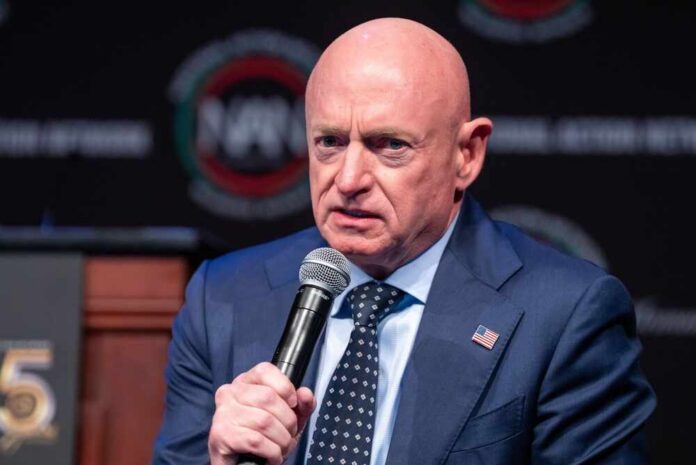
Sen. Mark Kelly’s newest trouble began after he discussed a classified Pentagon briefing in a Sunday interview, describing it as “shocking” how far the U.S. has dipped into its “magazines,” a reference to weapons stockpiles in the context of the Iran war. Defense Secretary Pete Hegseth responded on X, accusing Kelly of publicly discussing sensitive details and announcing that Pentagon legal counsel would review whether the remarks crossed a line.
The core factual dispute is narrow but high-stakes: Kelly’s comment was brief and did not disclose specific numbers in the public excerpts cited by outlets, yet the Pentagon treats even generalized descriptions of readiness and depletion as potentially sensitive depending on what was briefed and classified.
Why Kelly’s retirement status matters under military law
Kelly’s case is unusual because he is both a U.S. senator and a retired Navy captain, a status that can keep him within reach of the Uniform Code of Military Justice in limited circumstances. Reporting on the dispute highlights that retired officers can still face military administrative processes and, in rare scenarios, UCMJ-based action tied to alleged misconduct. That legal reality gives the Pentagon leverage that does not apply the same way to most civilian lawmakers.
On Monday in early May 2026, Hegseth escalated the matter beyond online criticism. Reporting indicates the Defense Department issued a censure letter for Kelly’s file and initiated a retirement grade determination process that gives Kelly a set period to respond, with an expedited timeline for completion. If the department ultimately substantiates misconduct, the practical consequence could include a demotion in retirement rank and a significant reduction in pension.
The earlier “illegal orders” feud that set the stage
The leak allegation did not arise in a vacuum. The Pentagon review revives a longer-running dispute that traces back to a November 2025 video featuring Kelly and other Democratic lawmakers with military or intelligence backgrounds urging troops and officials to refuse “illegal orders” and uphold their oaths. The administration framed that message as dangerous in the current climate, while supporters argued it echoed standard principles embedded in military ethics and the law of armed conflict.
Free speech vs. discipline: the unresolved tension
Kelly has argued the Pentagon’s actions are retaliatory and warned that targeting a retired service member for speech sends a message to millions of veterans: criticize the wrong people in power and you could be punished. The Pentagon, for its part, has emphasized “due process and impartiality” while declining to litigate facts publicly during an active review. At the same time, the dispute lands in a political era where both parties accuse the other of weaponizing institutions.
A key constraint on public analysis is that classification decisions and briefing content are not fully visible, making it hard for outsiders to judge whether Kelly repeated protected generalities or echoed something genuinely sensitive. Courts have also been drawn into the broader controversy. Recent reporting noted skepticism from a D.C. Circuit panel when earlier punishment efforts were argued, signaling that the judiciary may push back if executive-branch discipline appears to stretch beyond established authority or collide with constitutional speech protections.
What to watch next for Congress, the Pentagon, and the public
The immediate next steps are procedural: Pentagon counsel must complete its review, and Kelly will have an opportunity to respond during the retirement-grade process. Substantively, the political risk runs both directions. Conservatives who want classified briefings treated as serious business will demand clear standards and equal accountability. Civil libertarians—right and left—will watch for signs that military law is being used to chill political speech, especially when the speaker is an elected official with oversight responsibilities.
Sources:
Hegseth Defense Department Mark Kelly demotion unlawful orders
Hegseth censure Kelly unlawful orders
Pentagon launching review democratic Sen. Mark Kelly