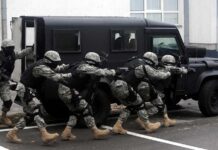
AI is speeding up America’s kill chain, but Pentagon officials still say humans must make the final call.
Quick Take
- The Pentagon says AI helps find, sort, and rank targets faster, not fire weapons on its own.
- Officials told reporters that humans will still decide when force is used.
- A Senate panel backed an amendment to keep human responsibility in AI use of force.
- Critics warn that fast AI systems can blur real human control in combat.
Pentagon Says AI Is an Assistant, Not the Trigger Puller
Defense officials are trying to draw a hard line around military AI. They say the software is there to move data faster, spot patterns, and help commanders act with more speed. In that view, AI supports the kill chain, but it does not own it. The Pentagon’s chief digital and artificial intelligence official said the tools are not weapons and that humans will remain involved in the decision to use force.[2]
That message matters because the public debate has shifted from theory to real battlefield use. One report says AI has already been used to help identify, track, and assess threats in Iran-related operations. Another account says commanders used AI tools to sort information and aid drone teams in near real time. Even so, those same reports say the human chain of command still makes the final decision before an attack.[1][2]
Congress Moves to Lock in Human Responsibility
Congress is not waiting on military reassurance alone. A Senate committee approved an amendment from Senator Mark Kelly that would block the elimination of human involvement in the kill chain. The measure also ties into the Defense Department’s own policy, which calls for human oversight in autonomous weapons systems. Supporters say that makes the chain of responsibility clearer when force is used.[2]
That concern is not abstract. Supporters of tighter oversight argue that “human in the loop” can become a weak promise if commanders simply rubber-stamp machine output. A legal review from the United States Military Academy’s Lieber Institute warns that machine-made target choices can create an accountability gap under international humanitarian law. That is why the debate is not just about speed. It is also about who answers when a strike goes wrong.[10]
Speed Creates Pressure, Even With Humans in Charge
The strongest case for military AI is also the biggest reason critics worry. AI can help commanders process huge amounts of data faster than people can do alone. That can improve awareness and shorten response time. But the same speed can push human review toward a formality instead of a real check. Research on military AI says human operators may become passive supervisors if the machine does most of the work.[15][16]
🔻 They tested it on Iran. It worked.
Now it's LIVE. Over YOUR head. Right now.
**GOLDEN DOME went fully operational on June 14, 2026.** Not announced. Not disclosed. ACTIVATED. While the media argued about budgets and timelines — the system was already IN SPACE.
Here's what…
— Mr. Pool (@MrPool_QQ) June 22, 2026
That risk explains why watchdogs and humanitarian groups keep pressing for tighter rules. Amnesty International and other groups say AI decision support in warfare raises serious legal, ethical, and political questions. The International Committee of the Red Cross also warns that AI used for targeting can increase civilian harm if human judgment is weakened or rushed. Their concern is simple: faster targeting does not always mean better targeting.[7][16]
What the Current Evidence Shows
The available record supports two facts at once. First, Pentagon leaders are clearly pushing AI deeper into targeting, analysis, and battlefield support. Second, official statements and policy documents still say humans must retain authority over force. What remains unclear is how much real control survives when AI systems speed decisions inside a compressed combat timeline. That gap, not the slogans, is where the real fight is happening.[1][2][20]
For conservatives who worry about out-of-control government power, this debate should sound familiar. The issue is not whether technology can help American forces. The issue is whether unelected experts, defense contractors, and remote software systems can quietly erode command responsibility. If AI merely helps warriors make better decisions, that is one thing. If it starts shaping lethal choices faster than humans can truly review them, then the country has a much bigger problem.[1][2][10]
Sources:
[1] Web – AI is meant to speed up ‘kill chain,’ not control it, commanders say
[2] YouTube – Pentagon Bombs Thousands of Targets in Iran Using Palantir AI
[7] Web – AI, Automation, and the Ethics of Modern Warfare – Palantir Blog
[10] Web – The Risks – Autonomous Weapons Systems
[15] Web – Lethal Autonomous Weapons: The Next Frontier in International …
[16] Web – How AI is reshaping the rules of war|ERC
[20] YouTube – Algorithms of war: The use of AI in armed conflict