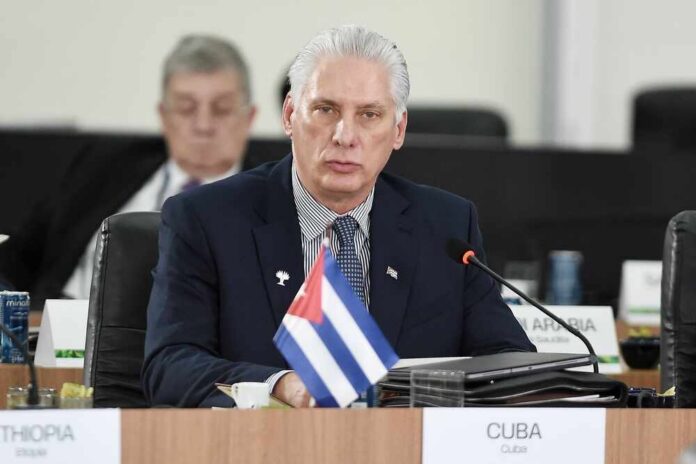
Cuba’s communist leadership just admitted it’s in talks with President Trump—after months of a fuel squeeze that has pushed the island into blackouts and desperation.
Story Snapshot
- Cuban President Miguel Díaz-Canel publicly confirmed negotiations with the Trump administration on March 13, 2026, calling the talks “in their first phase.”
- The talks are unfolding during a severe energy crunch; Díaz-Canel said Cuba has received no fuel shipments for more than three months.
- Secretary of State Marco Rubio has reportedly met with Cuban representatives at least six times in recent months, signaling a structured diplomatic track.
- The White House argues Cuba’s economic weakness gives the U.S. leverage, while Cuba’s diplomats demand “sovereignty and self-determination” in any deal.
Díaz-Canel’s Rare Public Admission Signals Havana Is Feeling Heat
Cuban President Miguel Díaz-Canel used a televised address on March 13 to confirm his government is negotiating with the United States, a notable shift for a regime that often prefers denials, slogans, and controlled ambiguity. Díaz-Canel said talks remain early and focused on building an agenda, while warning against “manipulation and speculation.” The admission matters because it concedes Havana is not merely enduring pressure—it is actively searching for an off-ramp.
U.S. officials have also confirmed the discussions, with reporting that Secretary of State Marco Rubio and senior aides have met Cuban representatives multiple times. That basic fact—repeated meetings at high levels—points to negotiations that are more than a trial balloon. Even so, neither side has laid out terms in public, and Cuban officials have declined to confirm reports about a near-term economic arrangement that could affect travel rules.
The Fuel Blockade Is the Leverage Point, and Cuba Says the Pain Is Real
The immediate backdrop is energy. Díaz-Canel said Cuba has gone more than three months without fuel shipments, producing a cascading shortage that hits transportation, industry, and daily life. Cuban diplomats have described the pressure campaign as “collective punishment,” emphasizing the civilian impact. U.S. officials counter that the regime’s vulnerability is self-inflicted and that economic weakness creates an opening for negotiations that could finally force structural change.
Reporting ties the fuel squeeze to wider regional shifts after the collapse of Venezuela’s ability to prop up Havana, once its most important oil backer. The Trump administration has also applied pressure to other potential suppliers, including Mexico, to reduce deliveries. The result is a negotiation environment built on hard leverage rather than the trust-first model favored during the Obama-era thaw—an approach many conservatives argue only bought time for a dictatorship without demanding real reforms.
Rubio’s “Incremental Change” Message Collides With “Friendly Takeover” Rhetoric
Two messages are coming out of Washington. President Trump has publicly predicted the Cuban regime could fall soon and has used “friendly takeover” language that suggests a dramatic political reset, including the possibility of Cuban exiles returning under different governance. Rubio, meanwhile, has indicated the administration could accept incremental transformation rather than immediate collapse, emphasizing that change may not happen all at once. That difference shapes expectations on both sides.
For American conservatives, the practical question is whether incremental steps would be conditioned on verifiable reforms—or become another one-sided concession. The public record so far shows a process without a published framework, leaving outsiders to judge by behavior: Cuba wants relief from crushing energy constraints, while the U.S. wants movement that goes beyond symbolism. Until terms are known, talk of timelines—either instant collapse or instant normalization—remains more politics than proof.
Vatican Mediation and Prisoner Releases Show the Quiet Channels at Work
Analysts cited in reporting say a managed transition is more likely than a sudden breakdown, and some recommend a mediator to reduce miscalculation. The Vatican is repeatedly mentioned because it has a long history of involvement in U.S.-Cuba contacts and recently engaged in talks with Havana tied to the release of 51 political prisoners. That does not guarantee a broader deal, but it demonstrates that third-party channels already exist and can produce concrete outcomes.
Another pressure point is credibility. Cuban diplomats insist that any agenda must respect sovereignty, while U.S. officials are signaling they see the regime as weakened and eager to bargain. If negotiations move forward, conservatives will watch whether humanitarian relief is paired with measurable political opening—especially as the regime’s track record includes censorship, political imprisonment, and state control of the economy.
What to Watch Next: Terms, Verification, and Whether Leverage Turns Into Reform
Both governments now agree on the core fact: negotiations are happening. What remains unknown is the trade—what the U.S. would ease, what Cuba would change, and how either side would verify compliance. If fuel and travel restrictions are part of the package, the key will be whether benefits flow through the Cuban state or reach private actors in ways that build independence from the regime. Talks are still agenda-setting, not deal-finalizing.
Cuban president admits talks with Trump admin as fuel blockade chokes domestic energy supply and economyhttps://t.co/EakMmCmSDZ
— Spreading Fox News (@SpreadFoxnews) March 14, 2026
For Americans who are tired of decades of foreign-policy games that reward bad actors, the Trump administration’s approach is being tested in real time: squeeze hard, talk seriously, and demand real-world change. The evidence so far supports only the basics—high-level meetings, public confirmation, and an energy crisis severe enough to force Havana to the table. Everything else hinges on the terms Washington is willing to sign and the reforms Cuba is willing to prove.
Sources:
Cuba is ready for talks with U.S. amid growing pressure from Trump
Cuba, U.S. confirm high-level negotiations after Trump predicts regime will fall