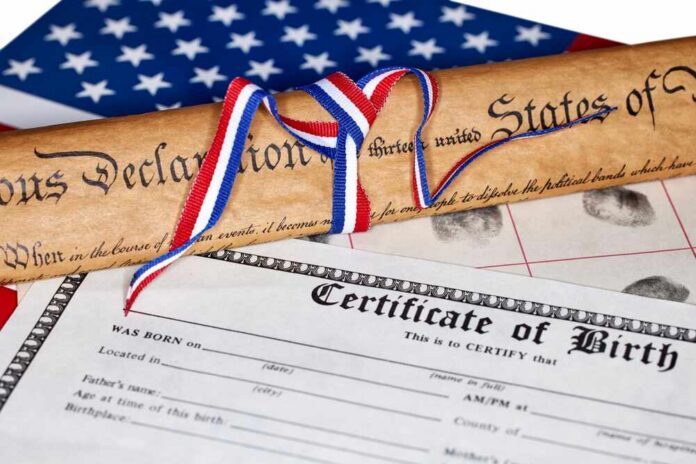
A policy debate once treated as untouchable is now on the Supreme Court’s doorstep—forcing Americans to decide whether citizenship should be a birth guarantee or a legal status with clearer limits.
Quick Take
- Polling shows a major gap between “ending” birthright citizenship and “limiting” it, suggesting wording drives public opinion.
- Multiple surveys still find broad support for the constitutional guarantee, even as a separate poll reports majority support for restrictions.
- The Supreme Court is considering whether a president can change birthright citizenship through executive action, raising separation-of-powers concerns.
- The fight exposes a deeper trust problem: many voters doubt Washington can enforce borders, follow the Constitution, and level with the public at the same time.
Why “Nearly Six in Ten” Depends on How the Question Is Asked
Polling around birthright citizenship has become a case study in how Americans respond to framing. One recent headline claim says nearly six in ten Americans support limiting birthright citizenship to children of U.S. citizens or legal permanent residents. Yet other major polls report the opposite trend when the question is phrased as “ending” birthright citizenship. That split matters because it shapes what elected officials claim voters want—and what courts may soon be asked to allow.
Ipsos polling published in 2025 reported that a majority of Americans opposed ending birthright citizenship, with a smaller share in support and a notable portion unsure. Other surveys described similar toplines: majorities favor keeping birthright citizenship as a constitutional guarantee, while opposition is smaller but politically energized. The apparent contradiction does not automatically mean one side is lying; it signals that “limit” versus “end” produces meaningfully different responses and policy expectations.
What the Constitution Says—and What the Court Is Being Asked to Decide
The Fourteenth Amendment’s Citizenship Clause has long been understood to grant citizenship to most people born on U.S. soil, a principle in place since the post–Civil War era. The current legal flashpoint is whether a president can narrow that rule through executive action, or whether any major change requires Congress and, more realistically, a constitutional amendment or a Supreme Court reinterpretation of key language such as “within the jurisdiction.”
This is where conservative instincts often collide: voters want secure borders and an end to incentives for illegal immigration, but they also want government constrained by constitutional limits. If a sweeping citizenship change can be done by executive order today, it can be undone by executive order tomorrow—exactly the kind of whiplash that fuels the public’s belief that Washington governs by power plays rather than durable law. The Court’s handling will signal whether constitutional text or political urgency sets the boundaries.
Partisan Numbers Show a Country Split—But Not Always Where You’d Expect
Survey breakdowns show the issue is strongly partisan, but not perfectly aligned. Democrats overwhelmingly support keeping birthright citizenship, while Republicans are more divided depending on the poll and wording. Some research also finds many Americans recognize birthright citizenship as a constitutional right even when they express policy frustration about illegal immigration and “anchor baby” incentives. That combination—constitutional awareness plus policy anger—helps explain why messaging battles are so intense.
Geography and coalition politics complicate the picture further. One academic survey found broad national support with only a few states dipping below 50% support. Other research shows independents often lean toward keeping the existing rule, even as they express skepticism of the federal government’s ability to manage immigration effectively. For Republican lawmakers, the political pressure is real: voters demand tougher enforcement, but they also expect legal clarity, predictable rules, and an end to bureaucratic gamesmanship.
What Changes Could Mean for Families, Enforcement, and Trust in Government
Policy outcomes are not abstract. Changes to birthright citizenship rules could affect mixed-status families and children born in the U.S. to parents without permanent legal status, creating uncertainty about documentation, access to services, and long-term residency. Survey research also indicates Americans are uneasy about harsh enforcement outcomes that separate families, even among voters who want stronger border control. That tension is one reason this debate keeps returning without a clean legislative resolution.
The broader consequence may be institutional: public confidence drops when leaders use slippery language—promising “limits” while opponents warn of “ending”—and when Washington appears to outsource hard decisions to courts. Conservatives who value ordered liberty tend to want immigration laws enforced consistently, while many liberals prioritize humanitarian outcomes; both sides increasingly share a suspicion that elites manipulate legal gray areas to avoid accountability. If the Court rules narrowly, Congress may still face pressure to legislate clearly rather than campaign on ambiguity.
Sources:
Majority of Americans Oppose Ending Birthright Citizenship
CHIP50 survey: American attitudes on immigration, birthright citizenship
Birthright citizenship approved by Americans, family survey
The New Immigration Crackdown: Where Americans Stand
New poll finds Americans want limits on birthright citizenship
U.S.-style birthright citizenship is uncommon around the world
Birthright Citizenship in the United States