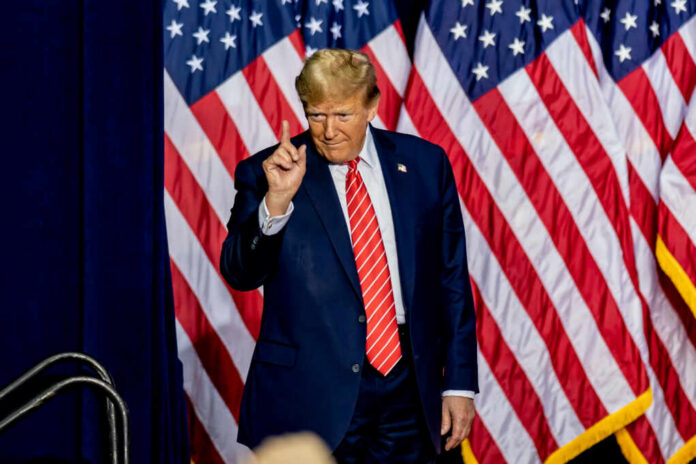
President Trump is walking into the Supreme Court in person to defend his bid to end birthright citizenship—an unprecedented move that’s reigniting a constitutional fight conservatives have wanted for decades.
At a Glance
- Trump said he would attend Supreme Court oral arguments on April 1, 2026, in a case tied to his executive order aimed at ending birthright citizenship.
- The visit would break modern precedent: no sitting president is known for attending oral arguments, a norm tied to separation-of-powers etiquette.
- The legal clash centers on the 14th Amendment’s “subject to the jurisdiction” language and long-standing precedent around automatic citizenship at birth.
- MAGA-aligned voters broadly support tougher immigration enforcement but are increasingly skeptical of executive power, institutional credibility, and “politics-as-usual” Washington.
Trump’s Supreme Court Appearance Raises the Stakes
President Donald Trump announced March 31 that he planned to attend Supreme Court oral arguments on April 1 regarding his executive order intended to end birthright citizenship. Trump said he is going because he has “listened to this argument for so long,” framing the moment as a personal and political turning point. The underlying dispute is not symbolic—it tests whether a president can move immigration policy by executive action where Congress has not acted.
Modern presidents generally avoid showing up for oral arguments to prevent even the appearance of pressuring the Court, even when they strongly favor one outcome. That norm is not a constitutional rule, but it is part of the separation-of-powers culture Americans rely on to keep the judiciary credible. Critics argue the optics invite politicization, while supporters see a president publicly defending an agenda voters elected him to execute.
The Birthright Citizenship Question: 14th Amendment vs. Executive Power
Birthright citizenship traces to the 14th Amendment, ratified in 1868, and to the Supreme Court’s 1898 decision in United States v. Wong Kim Ark, which is widely understood as cementing citizenship for most children born on U.S. soil. The contested phrase—“subject to the jurisdiction thereof”—has fueled debate for generations, especially amid illegal immigration and claims that automatic citizenship incentivizes “anchor baby” strategies.
Trump’s executive order attempts to reinterpret or narrow how the federal government applies that constitutional language. That approach creates an immediate constitutional tension: executive orders can direct agencies, but they cannot rewrite the Constitution, and courts typically resist any policy change that appears to bypass legislative authority. If the Court sides with Trump, it could reshape immigration law for the first time in a century; if not, it may reaffirm that this is a matter for constitutional amendment or congressional statute.
Why This Moment Hits MAGA Voters Differently in 2026
Immigration remains one of the clearest “kitchen-table” issues for Trump’s base, tied to jobs, public safety, and national sovereignty. But second-term reality has also sharpened another concern: whether Washington can deliver durable solutions without constantly expanding executive power. Politico reported polling showing significant public unease with aggressive enforcement tactics, highlighting that support for enforcement is not the same as blanket approval for every method used.
That matters because conservatives don’t just want a policy win; they want a legitimate win that survives court review and lasts beyond the next administration. A movement that has spent years warning about weaponized bureaucracy and government overreach now has to apply the same standard consistently—even when “their guy” is in office. The more immigration is governed by executive back-and-forth, the more unstable the system becomes.
Democratic Attacks Focus on “Danger” and Institutional Norms
Democratic leaders have used sharper language about Trump’s conduct and the risks of his decisions, portraying certain administration actions as dangerous or destabilizing. House Democratic Leader Hakeem Jeffries, for example, has argued publicly that Trump’s actions have put the country “in greater danger,” a claim offered in the context of broader critiques about presidential judgment. Those statements highlight the political reality: any Court outcome will be sold as either a rescue of the Constitution or a sign it is being bent.
For conservative readers, the key is separating rhetoric from enforceable law. The strongest factual point on the table is procedural and historical: a sitting president attending oral arguments is extraordinary, and extraordinary steps invite extraordinary backlash. If Trump’s legal theory is solid, it should stand on its constitutional footing—without needing performative gestures that hand opponents an easy “court intimidation” narrative.
What to Watch Next: The Ruling, DHS Enforcement, and Congressional Action
The Supreme Court’s decision—whenever it comes—will set the boundaries for how far any president can go on citizenship policy through executive action. In parallel, the administration’s immigration posture has been shaped by internal pressure for broader deportations and by leadership changes at DHS reported in major political coverage. Those crosscurrents show why the birthright case is not isolated; it sits inside a larger struggle over enforcement priorities and the legitimacy of federal power.
Conservatives who are tired of disorder at the border but also tired of constant institutional crisis should watch for one concrete follow-through step: Congress. A durable fix, if legally possible, will ultimately require legislation that can survive judicial review and future elections. Otherwise, the country stays trapped in a cycle where each administration governs by pen and phone—and the Constitution becomes a political football instead of the governing rulebook.
Sources:
Trump’s Next Move Will Make History, and the Left Is Furious
Leader Jeffries on WBLS: What Donald Trump Has Done Is Put Us in Greater Danger
Trump’s Operation Epic Fury Proves Reagan-Style ‘Peace Through Strength’ Back
Trump and History: Ignorance and Denial
Trump deportations immigration poll lobbying